In this article
Affiliate disclosure: Some links in this article are affiliate links. We may earn a commission if you buy through them, at no extra cost to you. It never changes our verdict.
Pros and cons
Pros
- I can use the distinct physical controls without looking
- I wore them through a workday without noticing pressure points
- I hear unusually clear voices and surroundings in transparency mode
- I get deep bass and plenty of detail without losing the mids
Cons
- I lose transparency mode when I turn on flat EQ
- The heavy case leaves part of the headphones exposed and has no cable storage
- Gaming and movies sound more closed in than I would like
Design
Does the unusual design hold up in daily use?
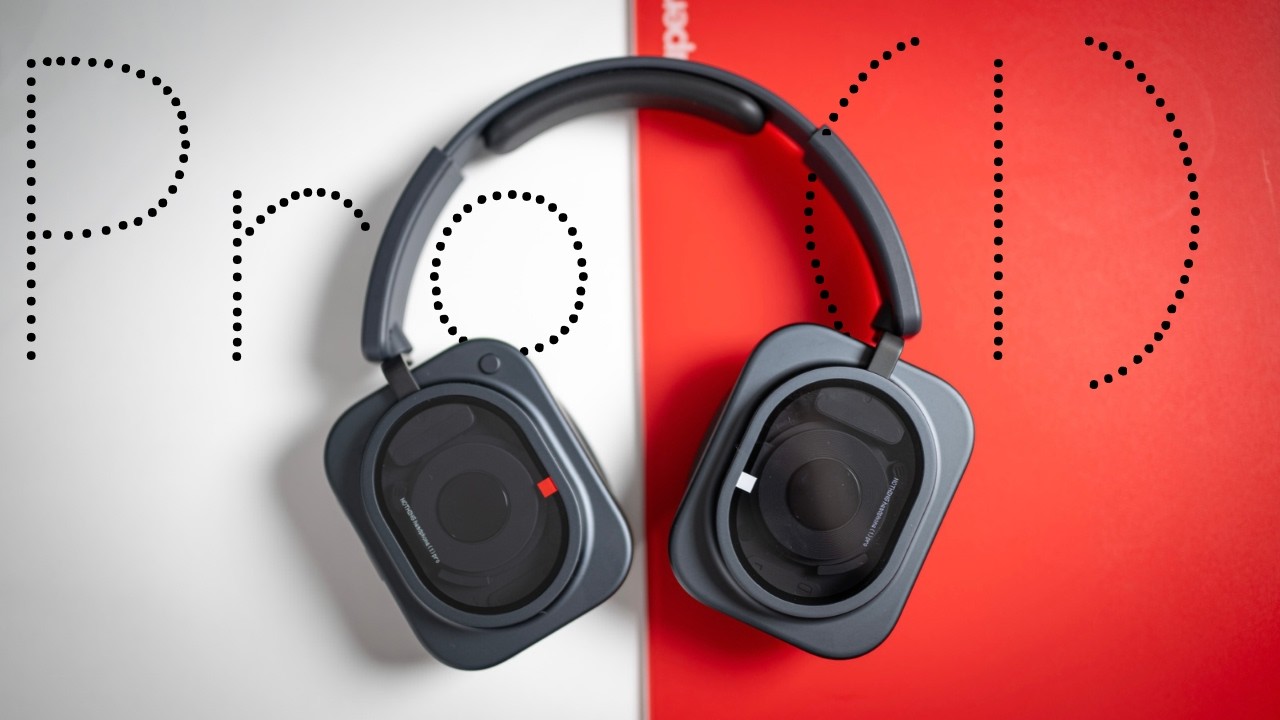
Watch this part of the video, from 0:27The Nothing Headphone (1) Pro looks unmistakably like a Nothing product, and I think the build feels better than the original Headphone (1). The aluminum housing has a nicer feel than I remember, while the titanium arms are lighter than the steel ones Nothing used before.
The outside uses Panda glass. Nothing says it has undergone drop testing and should resist shattering if it cracks; in my day-to-day use, I haven’t seen scratches on that glass. I can’t tell whether the material at the top is plastic or metal, so I won’t pretend I can.
Controls
Can I operate the Headphone (1) Pro without looking?
Watch this part of the video, from 2:43Yes. The roller, paddle and switches feel different enough that I know which one I’ve touched without taking the headphones off. I find that more natural and reliable than the touch controls on many headphones.
Roller
I roll it for volume, press it to play or pause, and hold it to switch between transparency and noise cancellation.
Paddle
I flick it to skip tracks, hold it to move through a track, or use it to answer a call.
Switches and action button
I get a power switch, a separate flat EQ switch and a configurable action button, as well as USB audio and a headphone jack.
Carrying case
How protective is the compact carrying case?
Watch this part of the video, from 4:17I prefer the case’s smaller footprint to a bulky full case, but it makes compromises. Its hard shell covers the important parts and has a soft, grippy interior, yet it weighs around the same as the headphones. There’s no place for a cable, either.
Part of the headphones remains exposed, which I think explains some scratches I got higher up. I’m also unsure how the headband cushioning will hold up where it might snag on the case. I haven’t used it long enough to know.
Comfort
Can I wear them all day or take them running?
Watch this part of the video, from 6:17The Headphone (1) Pro might be the most comfortable premium consumer headphones I’ve tried. The padding is thicker and wider than on the original, the ear cups pivot 20 degrees, and I wore this pair through an entire workday without noticing pressure points.
My ears got a little warm outside, but less so than with some other closed-back headphones I’ve tried. Running was a pleasant surprise: I could barely hear the footstep thud that bothered me on the original, and I didn’t hear creaking or parts knocking together. The IP52 rating makes them appealing for workouts, though I didn’t get the loaner very sweaty before returning it. If I buy my own pair, these will be my dedicated gym headphones.
Listening modes
How good are transparency and noise cancellation?
Watch this part of the video, from 7:55Transparency is more important to me than noise cancellation, and the Headphone (1) Pro has the best transparency I’ve heard from a non-Apple pair. Other people’s voices come through especially clearly, and outside I sometimes struggled to tell whether I had the headphones on. My own voice still has a slightly microphone-fed quality, but it’s much clearer than before.
Noise cancellation is really good, too. Nothing claims up to 46 dB of reduction, which I couldn’t scientifically test. Going by memory rather than a side-by-side comparison, I’d put it just below the best Sony and Apple headphones I’ve heard, and more than good enough for almost any situation.
App and EQ
Is the flat EQ switch worth using?
Watch this part of the video, from 9:52I spent most of my time with the Headphone (1) Pro in flat EQ mode. I usually want music to sound accurate, and this physical switch gives me a more neutral option without having to tinker with the app. Nothing developed the mode with Metropolis Studios to remove much of the usual coloration and processing.
There’s a catch I really feel: switching on flat EQ disables both the app EQ and transparency mode. I understand losing the EQ, but I want to hear my surroundings while using my preferred sound profile. I asked Nothing about it and told them I’d like that changed in a future firmware update if possible.
The Nothing X app also offers presets, a detailed custom EQ and spatial audio. I usually leave spatial audio off. One fix I did appreciate: unlike my experience with the original Headphone (1), using a custom EQ no longer seemed to lower the volume.
Sound
How do the triple drivers actually sound?
Watch this part of the video, from 12:40The triple-driver setup had me worried that the drivers might not sound well matched. I needn’t have worried. The Headphone (1) Pro sounds incredible for a portable wireless pair with noise cancellation, with deep, controlled bass and detail that kept revealing itself as I listened.
Each ear cup has a 40 mm dynamic driver, a separate precision dynamic driver and an xMEMS driver for the highest frequencies. The soundstage isn’t the widest I’ve heard: music can have a convincing sense of space when it’s in the mix, but games and movies stay more inside the headphones. Against my much larger reference headphones, this pair also sounds more closed in.
Bass and mids
Bass goes deep and can get louder with flat mode off, yet I can still follow the bass notes without losing the mids. Kick drums sound like kick drums. The mids are milder and a little subdued at first; after more listening, I started picking out more detail. Flat mode initially struck me as a little dull until I readjusted to its neutral sound.
Treble and the overall tuning
The highs are a bit recessed for my taste. I like more sizzle on cymbals, which I can get by turning flat mode off or using EQ. Overall, the tuning leans warm enough that I could listen for hours without feeling fatigued. Compared with my larger headphones, I still heard a lot of the detail, along with a punchy sound that’s fun to listen to.
Connection and battery
How did I listen, and how long should they last?
Watch this part of the video, from 18:19The Headphone (1) Pro supports LDAC, though much of my listening was through USB audio. For battery life, I expect about 30 to 40 hours with normal use, depending on how I use the headphones.
Common questions
Are the Nothing Headphone (1) Pro comfortable for all-day use?
Yes. I wore the Nothing Headphone (1) Pro through an entire workday without noticing pressure points. Its ear padding is thicker and wider than on the original Headphone (1), and the ear cups pivot 20 degrees. My ears got a little warm outside, as I’d expect from closed-back headphones, but I found them exceptionally comfortable.
Can you use transparency mode with flat EQ on the Nothing Headphone (1) Pro?
No. When I turn on the Nothing Headphone (1) Pro’s physical flat EQ switch, I lose transparency mode as well as the app EQ. Losing the app EQ makes sense to me, but transparency is one of my favorite features and I want to use it with the more neutral sound. I raised that with Nothing.
Are the Nothing Headphone (1) Pro good for gaming?
I tried gaming with the Nothing Headphone (1) Pro, but the sounds stayed fairly contained inside the headphones rather than spreading out around me. I heard a similar limitation for movies. I think music is where these shine: the triple drivers give me deep bass and plenty of detail, particularly with flat EQ on.
How good is noise cancellation on the Nothing Headphone (1) Pro?
I think the Nothing Headphone (1) Pro has really good noise cancellation, more than good enough for almost any situation. Nothing claims up to 46 dB of reduction, but I couldn’t scientifically test that figure. Based on memory, I’d put it a little below the best Sony and Apple headphones I’ve heard; I didn’t have those pairs for a side-by-side comparison.
Who should buy it?
Buy it if…
- You want a comfortable portable pair for long listening sessions
- You prefer physical controls and the option of a neutral sound profile
- You value clear transparency mode for conversations or running
Skip or wait if…
- You need transparency mode while listening with flat EQ
- You want a full-coverage case with room for cables
- You mainly want a wide, open soundstage for games or movies
Final verdict
A portable pair I didn’t want to send back
The Nothing Headphone (1) Pro is probably the best portable pair of headphones I’ve heard. Nothing got the comfort, controls, transparency and sound right, and the flat EQ switch gives me a tuning I genuinely want to use. I wish it didn’t disable transparency, but if I buy my own pair after returning this loaner, these are the ones I’d take to the gym.
Buying options
Where to buy the Nothing Headphone (1) Pro
Prices and configurations change often, so check the current price with the retailer.
These are affiliate links.