In this article
Pros and cons
Pros
- I love the bright OLED screen and its anti-reflective coating
- I can make finer adjustments with the TMR thumbsticks
- The improved face buttons and rear grips feel better to use
Cons
- Newer AAA games struggle on the Ryzen Z2 Extreme
- I don’t get a microSD Express card reader
- I couldn’t tell much difference between the D-pad’s two profiles
Gaming performance
Can the ROG Xbox Ally X20 handle newer AAA games?
Watch this part of the video, from 0:49The ROG Xbox Ally X20 struggled with the newer AAA games I wanted to play. I’m happy gaming at 30 or 40 FPS, but barely reaching 30 FPS with poor frame pacing made aiming and getting into a game difficult. That’s a serious problem for a premium handheld.
Halo: Campaign Evolved barely reached 30 FPS unplugged at low settings. Plugging in got me 40 FPS, but it wasn’t consistent and still felt sluggish. I suspected the low frames were the reason. Gears of War: E-Day felt much the same at low settings with lower FSR: it sometimes jumped into the 40s, but never felt like a solid 40 FPS experience. I couldn’t get 007 First Light to 30 FPS at all.
What I saw while playing newer games
| Halo: Campaign Evolved, low settings, unplugged | Barely 30 FPS |
|---|---|
| Halo: Campaign Evolved, low settings, plugged in | 40 FPS, inconsistent |
| Gears of War: E-Day, low settings with lower FSR | Barely 30 FPS; occasional jumps into the 40s |
| 007 First Light | Below 30 FPS |
Longevity
Why lowering resolution and using frame generation don’t change my mind
Watch this part of the video, from 2:04I don’t want to drop to 720p on a premium handheld in 2026. At the frame rates I was getting, frame generation made the experience worse rather than rescuing it. I’m already questioning how the Ally X20 will handle games a year or two from now, given how it plays the newer titles I tried.
AMD moved from the Z1 Extreme’s Zen architecture and RDNA 3 graphics to newer Zen 5 CPU cores and RDNA 3.5 graphics in the Z2 Extreme. In my testing, the gaming performance improvement was only about 15% across just about every game. Some Z2 Extreme game results shown as estimates were scaled from measured Z1 Extreme results using the Steel Nomad Light score difference, rather than measured Z2 Extreme game results. Going from the original ROG Ally in 2023 to this handheld in 2026, I don’t think most people would notice much difference in gaming performance.
Other chips
How does the Z2 Extreme compare with newer laptop chips?
Watch this part of the video, from 3:33The Z2 Extreme looks less convincing to me now that I’ve tried newer chips at comparable power limits. In Panther Lake laptops I tested, I could even game at 1440p at power levels between 30 and 45 W. I don’t see the Ally X20 doing that.
I also saw nearly double the frame rates in my testing of laptops with NVIDIA Spark at 30 W. Those laptops cost significantly more, and an ARM chip in a handheld would require translation for x86 games, so I’m not treating either laptop result as a handheld benchmark. They do show why I wanted more from the chip in this Ally.
Controls
What improved about the Ally X20's sticks, buttons and grips?
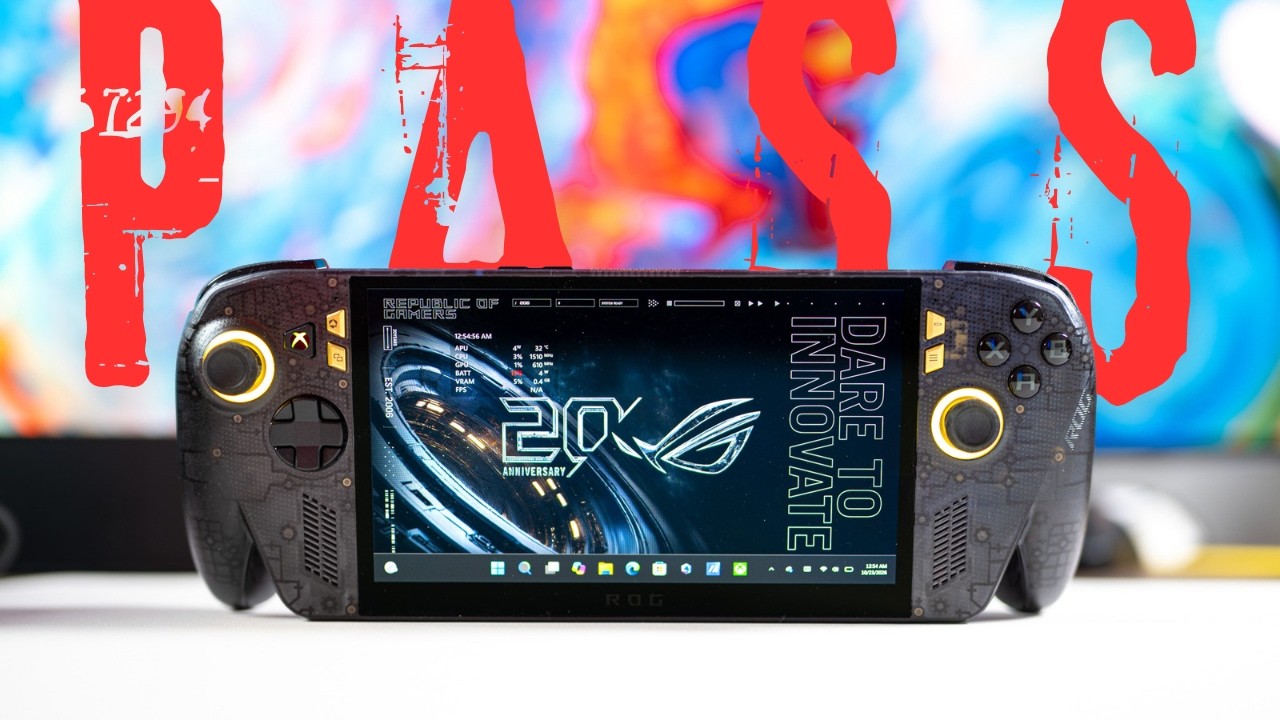
Watch this part of the video, from 5:12The ROG Xbox Ally X20 feels like a generational hardware improvement in my hands. The TMR thumbsticks are my favorite change: they have more tension than the previous Xbox Ally’s mushier sticks, and I can make fine adjustments without the dead zone I noticed before. Their latency seems better to me, too. ASUS says diagonal movement has improved, and I think I can feel it.
The face buttons fix another irritation I had with the previous Xbox Ally. Those buttons felt too stiff and didn’t always bounce back the way I wanted. The X20's are softer, with less travel and a slightly mushier feel, but I was landing moves in Tony Hawk more reliably. The rubber grips on the back also make a noticeable difference to comfort.
Do the smaller control changes matter?
The rotatable D-pad is supposed to offer four-way and eight-way profiles, but I haven’t noticed much difference between them. The triggers are slightly better, though it’s a minor change. I like the sleek anniversary color and redesign, even if those are cosmetic.
Display
How good is the Ally X20's OLED screen?
Watch this part of the video, from 6:45The Ally X20's OLED is fantastic. It’s bright, and ASUS’s anti-reflective layer cuts reflections while keeping the contrast and punch I like from a glossy display. It worked well when I took it outside on an overcast, slightly rainy day. I don’t know how it would fare in direct sunlight, and I don’t think that’s where I’d choose to play.
I also like that ASUS kept a 16 by 9 aspect ratio for a gaming handheld. The 7.4 in, 1080p panel supports HDR, which looks fantastic to me. Its FreeSync range starts at 30 Hz rather than the original panel’s 48 Hz, a useful change when the games I played struggled to reach 30 FPS.
The calibration is another strength. It may look less punchy than displays with boosted saturation, but to my eyes it looks remarkably accurate and closer to how the games were designed. The original IPS screen was starting to show its age beside it.
Alternative
Would I upgrade my current handheld another way?
Watch this part of the video, from 9:41If I wanted to give an existing handheld a new feel, I’d consider the ROG XREAL R1 glasses instead of buying the Ally X20 for its OLED screen. ASUS sent me the glasses for review, and they’ve changed how I’ve been gaming: I can use their micro-OLED display rather than looking down at a handheld’s screen.
Lately I’ve also preferred connecting a controller to one of the newer laptops I mentioned. Neither changes how much I like the Ally X20's hardware, but both make it harder for me to justify replacing a working handheld with this chip.
| Feature | Original ROG Ally | ROG Xbox Ally X20 |
|---|---|---|
| Panel | IPS | OLED |
| FreeSync range | 48 Hz to 120 Hz | 30 Hz to 120 Hz |
| HDR | No | Yes |
Common questions
Is the ROG Xbox Ally X20 good for newer AAA games?
I wouldn’t buy the ROG Xbox Ally X20 for newer AAA games in 2026. Halo: Campaign Evolved barely reached 30 FPS unplugged at low settings in my testing, Gears of War: E-Day had similarly uneven performance, and I couldn’t get 007 First Light to 30 FPS. Those games are why I decided not to keep mine.
Is the ROG Xbox Ally X20's OLED screen worth upgrading for?
I love the ROG Xbox Ally X20's OLED screen. It’s bright, its anti-reflective layer worked well for me outdoors on an overcast day, and HDR looks fantastic. FreeSync now starts at 30 Hz, which helps with lower frame rates. I still wouldn’t upgrade an existing handheld just for this screen while the chip limits newer games.
Should I buy the ROG Xbox Ally X20 or keep my current handheld?
I’d keep my current handheld and wait for a newer ROG Ally with a stronger chip. The ROG Xbox Ally X20 has more precise TMR sticks, better buttons and a lovely OLED, but its Ryzen Z2 Extreme disappointed me in newer AAA games. I bought one excited to try it, and I won’t be keeping it.
Final verdict
I’d wait for a better chip
ASUS got so much right with the ROG Xbox Ally X20 that I wish I could recommend it. Its controls, comfort and OLED are meaningful improvements. But I bought it, played newer AAA games, and was reminded how limiting this level of performance feels now. I don’t think you should buy this version in 2026. I’d keep an existing handheld and wait for ASUS to update the chip.